IV drug abuse blamed for rising HIV infection rate in parts of India

CHENNAI, INDIA–David, 37, injects heroin daily–a schedule that has never varied for the past 15 years. Despite perpetually running short on cash to buy his fix, he has never been desperate enough, he says, to share needles.

A drug addict injects despite HIV fears
Audio slideshow: A drug addict injects despite HIV fears

“I know how HIV goes from one body to another,” David says. “I’ve seen many friends get sick and die like that.”

Still, David admits that when he finally faces the dire choice between buying a new needle or heroin, his addiction will overcome his fear of HIV.

David remains HIV negative but his dependence on heroin puts him at an enormous risk. A study released in November by UNAIDS and the World Health Organization notes that intravenous drug use is the main risk factor for HIV infection in north-east India, and now plays a growing role in major cities like Chennai, Mumbai and New Delhi.

The study shows that efforts to help drug users tend to be at best “inconsistent, too small and infrequent” to make a dent. If an urgent effort is not made to expand programs that help addicts, the study found, there is a strong possibility that intravenous drug use combined with paid sex could make the HIV epidemic in India far worse.

Needle exchange programs, which have proven to reduce the rate of infection among addicts in Europe and the United States, are almost non-existent in India. The Indian government notes that such programs are “frowned upon in India because of ethical and moral implications” of appearing to condone drug abuse.

That political attitude leaves David with few choices. He depends on his 68-year-old father’s meager pension to survive, and as his father’s health dwindles so do the days of not sharing needles.

ARV production is an Indian government responsibility

Human Rights Watch recently invited Lives in Focus to collaborate on a Web log in conjunction with the XVI International AIDS Conference in Toronto, Canada from Aug. 13-18.

One of the speakers, Anand Grover, the co-founder of the Mumbai Lawyers Collective HIV/AIDS Unit, delivered a speech on the second day of the conference titled “Human rights and Social Vulnerabilities,” in which he expressed concern about the availability of inexpensive generic drugs in five to ten years with India’s agreement to comply with the Agreement on Trade -Related Aspects of Intellectual Property Rights (TRIPS) regarding product patents.

Lives in Focus had interviewed Grover in Mumbai earlier about this subject and asked what alternatives there are to Western pharmaceutical companies imposing licenses on Indian generic drug makers and why the Indian government itself does not begin production of the drugs. Listen to his thoughts on the subject in this audio clip.

Audio clip: Adobe Flash Player (version 9 or above) is required to play this audio clip. Download the latest version here. You also need to have JavaScript enabled in your browser.

Related Previous Posting:

Anand Grover addresses the gulf between the Indian government’s statistics and NGOs statistics on the number of people infected with the HIV virus. (Audio Interview).

Anand Grover discusses condoms and Morality (Video Interview).

Making a big decision

Hear Dr. Troy, as he is known, explain how he decides which child should remain in the custody of his or her extended family and which child will be admitted as an orphan to the center.
Dr. Troy Cunningham

Troy Cunningham did not intend to spend too much energy in his temporary job as an HIV/AIDS awareness counselor in the late 90s. He had taken one year off to study for his medical entrance exams and was told this job entailed light work and plenty of time to study. He brought his books with him, but what he saw grabbed his full attention. Back in medical school, he independently studied what he could about HIV/AIDS because there were no official courses on the disease. Now at 35, he heads the medical staff at the Freedom Foundation in Hyderabad and helps the center make its most critical decision.

Listen to Dr. Troy, as he is known, explain how he decides which child should remain in the custody of his or her extended family and which child will be admitted as an orphan to the center.

Audio clip: Adobe Flash Player (version 9 or above) is required to play this audio clip. Download the latest version here. You also need to have JavaScript enabled in your browser.

HIV contaminated blood

click image for video

Raj Shekhar was 30-years-old when he needed a blood transfusion after an accident. That transfusion, more than the accident itself, changed his life unexpectedly. Nearly a year later, he tested HIV positive when he was hospitalized after experiencing massive chest pains. Instead of being admitted to the operating room, he says, his doctor refused to perform the required surgery. His wife abandoned him soon after.

Raj is among the approximately five to ten percent of the global HIV+ population that was infected through contaminated blood five years ago. The World Health Organization (WHO) estimated in 2003 that nearly seven percent of AIDS patients who have reported their condition to the National AIDS Program in India acquired the virus after a transfusion of blood or blood-related products like plasma.

WHO research shows that regular, unpaid voluntary donors provide safe and sustainable blood supply because they are less likely to lie about their health status and are also more likely to keep themselves healthy. South Africa, for instance, has an HIV prevalence of 23.3 percent in the adult population but only 0.03 percent among its regular blood donors, the WHO reported this week for World Donor Day 2006 on Wednesday.

International health organizations have made a concerted effort to improve and secure the standards of blood collected for transfusion by proposing 100 percent unpaid, voluntary blood donation. But the world is making slow progress towards that goal. Most developing countries still depend on paid donors (many of whom are in dire economic situations from drug or alcohol abuse) or family member donors (who are often too ashamed to reveal their HIV status).

The WHO survey shows that out of the 124 countries that provided data to WHO, 56 saw an increase in unpaid voluntary donation. The remaining 68 have either made no progress or have seen a decline in the number of unpaid voluntary donors. Of the 124 countries, 49 have reached 100% unpaid voluntary blood donation. Out of those 49, only 17 are developing countries.

However, some countries such as Malaysia and India have shown progress in the last two years by applying stricter principles within their AIDS prevention programs. The WHO said Malaysia went from 50 percent in 2002 collected blood coming from unpaid volunteers to 99 percent in 2004 and India from 45 percent to 52.42 percent.

Raj was transfused five-years ago when blood harvesting programs in India had few safeguards. In this video interview, Raj reflects on how his life changed after he was transfused with HIV tainted blood.

What did marriage bring me?

But perhaps the most  insightful look into Shabana's delicate psyche came at the end of the interview when she asked if she could pose a question.
Shabana

Shabana, 20, realized she was HIV+ after her husband’s health began rapidly deteriorating. A Muslim woman, she now serves as a counselor trying to educate those in her community about the dangers of HIV/AIDS and how it spreads.

Lives in Focus has profiled her in a video interview and talked to her mother about how she handled her daughter’s situation. But perhaps the most poignant glimpse into Shabana’s delicate psyche came at the end of the interview when she asked if she could pose a question.

Listen to her in Hindi.

Audio clip: Adobe Flash Player (version 9 or above) is required to play this audio clip. Download the latest version here. You also need to have JavaScript enabled in your browser.

With English voiceovers.

Audio clip: Adobe Flash Player (version 9 or above) is required to play this audio clip. Download the latest version here. You also need to have JavaScript enabled in your browser.

Related Previous Postings:
A mother’s love (Podcast).
Shabana’s hopes (Video Interview).
Facing the Glare (Photography).

The Age of AIDS

click for video preview

Lives in Focus editors highly recommend a new documentary titled “The Age of AIDS” which is produced by Frontline, one of the world’s best television news magazine programs. The four-hour documentary is a must-see if you want a deeper understanding of this disease. The program describes itself thus:

After 25 years of political denial, social stigma, scientific breakthroughs, bitter policy battles and inadequate prevention campaigns, HIV/AIDS continues to spread rapidly throughout much of the world. Through interviews with AIDS researchers, world leaders, activists, and patients, FRONTLINE investigates the science, politics, and human cost of this fateful disease and asks: What are the lessons of the past, and what can be done to stop AIDS?

The full program will be available here beginning Friday, June 2 at 5pm New York time.

Working in the Middle East and HIV

Nirmala Kumari worked as a domestic worker in the Middle East for nearly ten years. She earned a good salary—especially when compared to Indian standards for the same work. She wired most of her earnings to her husband every month to help care for their two sons and saved some for a ticket back to India every two years.

Nirmala
click image for audio slideshow

While she was thousands of miles away for those long years, her husband visited prostitutes using the very money Nirmala sent home.

Nirmala is one of hundreds of thousands of Indian men and women who work in the Gulf as menial laborers doing the jobs native Arabs refuse. The distance and airfare keep them in the Middle East for years at a time.

The long periods of separation can lead to indiscretions. The problem is compounded within extended families. A young woman diagnosed as HIV positive confided to a social worker in Hyderabad that her brother-in-law had frequently raped her while her husband worked in the Middle East. Another man described his need for companionship while his wife was away.

Nirmala, now 35, says she continued to love her husband even after she discovered his infidelity. She continued to love him as he died of AIDS. HIV positive herself, she hopes to rebuild her life. She would like to return to Dubai to earn higher wages but worries about her health once she runs out of the ARVs supplied by the Indian government. Nirmala says she would not dare seek medical treatment for the disease in the Middle East—a sure-fire way to be deported.

Click the image above to view English captions while Nirmala speaks.

Listen to her in Telugu.

Audio clip: Adobe Flash Player (version 9 or above) is required to play this audio clip. Download the latest version here. You also need to have JavaScript enabled in your browser.

Elderly mothers bear AIDS burden

In countries with a high prevalence of AIDS, the epidemic decimates the young to middle-aged adult population—the backbone of the labor that supports both the national economy and the family.

Elderly Mother Bears AIDS Burden

In the absence of men and women of working-age, older relatives often resume the burden of being breadwinners and caretakers. More often than not, this task falls on elderly women.

A study published in 2002 by HelpAge International, a U.K.-based non-profit that champions older people worldwide, noted the following:

One outcome in countries with high HIV/AIDS prevalence is an increase in the number of chronically poor households headed by older women, with a large number of dependents. Older women generally suffer most from chronic poverty and lack of resources. They are often in need of care themselves, but face, sometimes unaided, the costs and emotional stress of nursing terminally ill relatives, paying for burials and the financial and practical difficulties of bringing up orphans - including payment of school fees.

While the study was published four years ago, the effects described are still the reality. During the summer of 2005, Srinivas and I often noticed elderly mothers at hospitals and care centers unwilling to abandon their sons or daughters to the epidemic.

Despite setbacks, Bikhshapati is full of life

click image for video

When I first asked Bikhshapati his age, he didn’t understand my question. I asked again, “Are you five? Six?”

He answered in English but seeing the confusion on my face, he reached down and scrawled the number “12″ in the sand.

I was shocked. For a moment I suspected he wrote the wrong number.

His doctor told me later that Bikhshapati looks half his age because of the ravages of HIV. Although he is on anti-retro viral drugs, his body constantly struggles against the virus. On many occasions over the past few years, he has fallen deathly ill. He has missed school so often that he is now years behind those his own age.

Bikhshapati’s hardships have not dimmed his enthusiasm for life, however. For those of you struggling emotionally with being HIV positive, this young Karate fighter’s bright disposition might provide some inspiration.

A glimmer of hope: HIV infection drop in South India

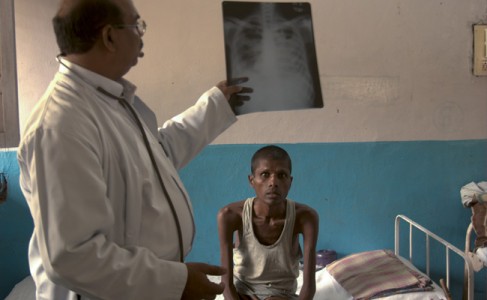
Dr. K. Venu, chief of Hyderabad’s Government General Chest Hospital, treats an unrelenting stream of patients who come to the hospital for Tuberculosis treatment only to find that they have AIDS. In India, TB is the most lethal opportunistic infection preying on those weakened by AIDS.

click image for video

Despite the human toll he witnessed over the past decade, Dr. Venu remains optimistic about controlling the spread of HIV/AIDS.

He might have reason to be hopeful.

A study published March 30, 2006 in the British medical journal, The Lancet, provides a glimmer of hope.

The research, conducted by a joint Indian and Canadian team, found that India’s safe sex awareness campaign has had a dramatic impact on reducing HIV infection rates in South India—the epicenter of India’s AIDS crisis. The study suggests that HIV infection rates have fallen by a third in the worst hit regions of South India.

The research tracked HIV infection rates at the clinics where people normally find out they are infected, including among young women attending pregnancy clinics, and young men attending sex disease clinics.

The researchers studied HIV prevalence data from 294,050 women attending 216 antenatal clinics and 58,790 men attending 132 sexually transmitted infection clinics in the north and south from 2000 to 2004.

Despite his optimism, Dr. Venu warns that while the trend is encouraging, there is no time for apathy.

Related Previous Posting:
Opportunistic Infections (Photography).